
My First Byline: Dan Barkin
Contributing writer, Business North Carolina

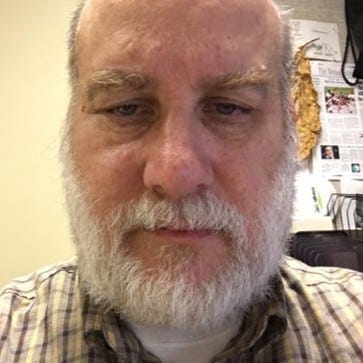
What is your current job?
I retired from The News & Observer in 2018. Since 2018, I have written for Business North Carolina magazine, a monthly publication. My focus has been on the defense ecosystem in North Carolina. The military is the second-largest sector in North Carolina’s economy, in part because we have the fourth-largest number of military personnel among the states. Two years ago, for the magazine, I started writing a weekly email newsletter called the NC Military Report. I still write a column for the magazine.
What was your first byline?
In 1973, I took a year off from college to work for my uncle’s re-election campaign. He was the mayor of my hometown. After the election, I was looking for something to do until I was scheduled to return to college in January. My mother knew the editor of the local weekly paper, and she suggested that I go down there an interview to be a stringer. I did, and was immediately assigned a local community meeting to cover. There was some development that was proposed, and the neighborhood was agitated. I came back from the meeting and wrote the story on a typewriter. The editor read the story and said it seemed to be complete and clear, but she just had one suggestion. I had written the story chronologically, because I did not know how else to tell a story. She told me about the inverted pyramid. Take your last paragraph, and put it at the top, she said. That was my first journalism lesson. The story was published, and 52 years and some months later, I am still a working journalist. I got into journalism because I liked to write and tell stories, and I still do.
What was your first real job in journalism?
My first paying job as a journalist was at a small daily in Southwest Virginia, the Martinsville Bulletin. The Bulletin came out six days a week (not Saturday), and it was an afternoon paper, with a circulation of around 18,000 and a very high penetration rate. Everyone read the Bulletin. Martinsville was a typical town in the Piedmont, with textiles and furniture factories before automation and foreign competition decimated both sectors. I worked there for five years and met my wife there, before we moved to Norfolk so I could work for the Virginian-Pilot.
Do you know a journalist who you think should be featured in a My First Byline? Tell us using the form below.
How did you get it?
I had a friend who helped me get in the door. Sam Barnes was my roommate at the University of Virginia and he also worked with me on the student newspaper, the Cavalier Daily. We were the same age, but he was a year ahead of me because of my year off, and he was the managing editor of the CD. I was a reporter. After Sam graduated, he got a job in Martinsville, which was not far from his hometown of South Boston, Va. In early September of 1975, there was an opening on the Bulletin staff, and the editor, Dennis Hartig, went to Sam and asked if he knew anyone who might want a job. Sam mentioned me, and Dennis told him to have me call him, which I did.
I drove my pickup truck, a Ford 150, down to Martinsville and they put me up in the Broad Street Hotel across from the paper. It was a big old boarding house owned by an old lady who was probably my age now. I had been brought down for a tryout. Dennis wanted to see me in action, live, and not go by my clips. I would be paid for the week, and at the end, I would learn if I had the job. It was a tough week because so much was riding on it. About this time, a woman named Lynette “Squeaky” Fromme — a member of the Manson Family — tried to shoot President Gerald Ford. Following her arrest, this focused some considerable attention on the members of the Manson Family who were not in prison — there were a few of them who, for one reason or another, had not participated in the Helter Skelter murders of Sharon Tate and others.
One of these Manson Family members was Sandra Good. She took advantage of her sudden, Squeaky-adjacent celebrity, to declare war on capitalism, and vowed that CEOs of big companies would be “viciously, viciously slaughtered.” She said she was in the midst of compiling a list of targets. She said this to network and wire service reporters at a press conference.
Dennis, my editor — at least for the week — came to me and said, basically, well we have some of the biggest industrialists and CEOs in the textile and furniture industry, I wonder if any of our people are on her list. Because if they are, it would be a public service to let them know. You should try to talk to her, he told me.
The week had taken a turn. I thought about it for a while. Our wire service at that time was United Press International, and so I placed a long-distance call to the UPI bureau in San Francisco. The desk guy answered and I explained to him that I was in Martinsville, Va., at a client newspaper, and wondered if he had a phone number for Sandra Good, because I needed to ask her if she intended to kill, for example, Harry Gravely, the president of Gravely Furniture. The UPI fellow said, oh, yeah, we have her number because she calls a lot. So I dialed the number and Sandra Good answered. As I had with my call to UPI, I explained who I was and why I was calling, and asked if she had any Virginia industrialists on her target list. I recall her pausing and then asking me to call back in a couple of hours. In retrospect, years later, the thought occured that she may have run down to the public library reference room for names. When I called back, she had names. Her hit list had expanded to Virginia. I wrote the story and it appeared under a very large headline on the front page.
On Friday, Dennis offered me the job. Some years later, he told me he had decided by about Day Two that he was going to hire me, and I recall telling him that it would have been nice to know as I was working on the Manson death squad story that my future didn’t depend on getting a very addled Sandra Good to cooperate. Four years later, Dennis was the best man at my wedding, and a year after that, he brought me to the Virginia Beach bureau of the Virginian-Pilot. He also taught me most of what I know about reporting and being punctual.
What advice do you have for people looking to break into journalism?
a. I recommend, if you want to break into journalism, that you go to a very good journalism school. There are a lot of so-so places that have journalism programs, but these are not heavily recruited. The faculty may or may not have people calling them with openings. Media organizations recruit at good journalism schools. This is not an ironclad rule, because there are exceptions. I know the exceptions. I was one. But if you are going to commit to a journalism education, try to get to a blue-chip program. It is always a good idea to ask where recent graduates are working and who recruits here.
b. Internships matter a lot. For one thing, they often can lead to a job. You will gain references from active editors, beyond whoever taught you copy editing last semester, a professor who may not have any current contacts. Professors can be OK references, sometimes, but journalism programs are in business to place their graduates. You will seldom get a professor to tell you if a student is meh. Internships are also a good way to build a portfolio beyond your college paper or website. Although, some of the best internship clips were written by anonymous editors, so there’s that.
c. Be very strategic about applying for jobs. Applying for a job is like bidding on a military contract. Before you submit a bid, you should talk to the contracting officer, let him know who you are and your capabilities. You try to figure out who is making the decision. You should know a lot about the requirements of the contract, and shape the bid accordingly. You should follow the instructions of the bid solicitation down to the font and point size. You should not just toss in a bid and hope for the best. Breaking into journalism is a project that favors the folks who do the research, travel to job fairs and conferences, and focus their energies. And it favors people who didn’t just wake up this morning and decide they wanted to be journalists.
It is important to realize that you are competing with a lot of talented, driven young people who have been working throughout their undergraduate years to get a job in journalism, possibly since middle school. They have done all the things noted above. If you are just starting to think about this in the spring semester of your senior year, you are not going to get a good job in journalism unless you are very lucky. The competition is very tough.
What I have learned covering the military is that if you want to become a general, you should specialize in an area that requires more brains than brawn. There is no shortage of infantry officers who all want to be generals. But the Army also needs senior leaders of IT and logistics. If you want to become a general, you should specialize very early on in IT or logistics.
Similarly, one of the best ways to break into journalism is to take come accounting classes and specialize in business journalism. Get business journalism internships at places like Bloomberg. There are a lot of business news sites. One reason there are is that people will pay money for solid, timely business news and information. That is where a lot of opportunities are. There are also a ton of specialized business publications that focus on specific industries. This has been called the trade press, but there are a lot of jobs at the trades. Again, it is because people will pay for the information in ways that they won’t pay for school board news.
Find Dan on LinkedIn.
Dan Barkin gave me my first big internship at the N&O back in the day. Forever grateful for that!